Intelligent Research, Redefined
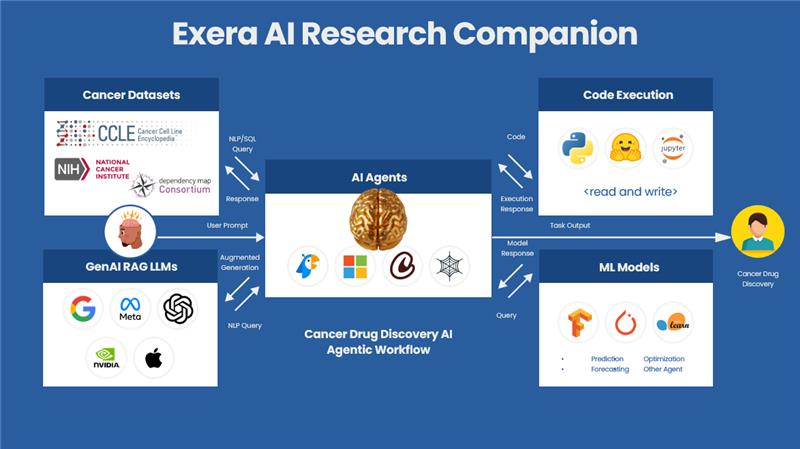
exera’s Augmented Research Companion is a next-generation AI assistant purpose-built for researchers, clinicians, and public health experts. It acts as an autonomous yet auditable co-pilot that rapidly ingests internal and external data, synthesizes findings, and supports complex hypothesis generation with contextual awareness and domain specialization.
This intelligent assistant goes beyond traditional search—it augments scientific thinking. Whether optimizing treatment protocols for underserved populations, forecasting disease progression, or identifying gene-disease correlations, the Companion acts as a research multiplier. It has already demonstrated up to 50–60% time savings in oncology trials, accelerating both R&D and regulatory readiness.
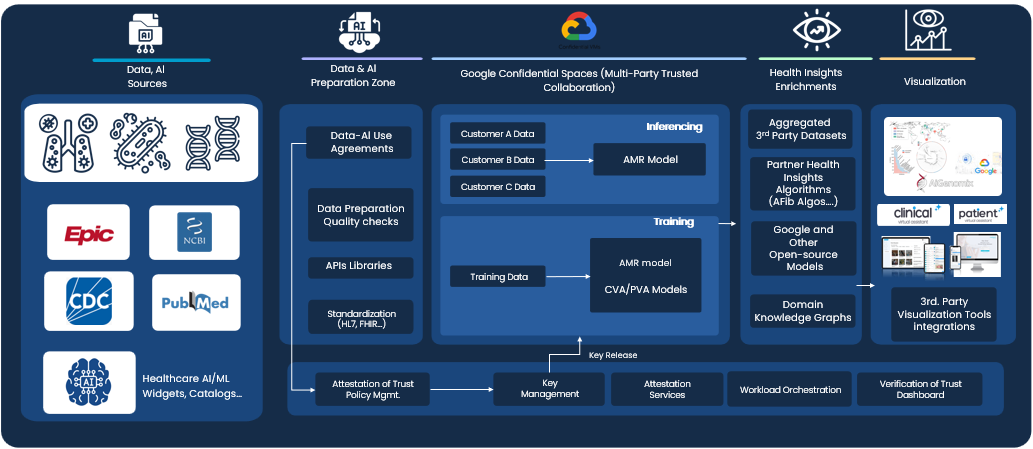
Built on confidential computing principles, our system ensures that all insights are derived within a secure enclave. The platform operates through a federated, API-first framework with explainable output and multi-agent orchestration—meaning no black boxes, and no compromises on trust.

Use cases
Focused on healthcare, finance, energy, manufacturing, and retail-driving innovation, efficiency, and growth through tailored AI-driven solutions.
Healthcare
Analyze EHRs, genomics, and outcomes for treatment effectiveness

Life Sciences
Rapid literature synthesis and drug repurposing identification

Public Health
Surveillance, adverse event tracking, population-level interventions

Defense Health
Clinical decision support under data-governed environments

Product Roadmap
From Beta to Autonomous Scientific Reasoning
Our current beta version delivers multi-agent enterprise search with GenAI-powered summarization, enabling faster decisions in real-world clinical and research scenarios.
Beta Release (Now):
- Multi-agent workflow for oncology and clinical trial analysis
- Enterprise data ingestion and federated querying
- Integrated prediction and evidence synthesis models
Phase 2 (Next 6–12 Months):
- Self-learning contextual agents capable of dynamic reasoning
- Integration with biomedical graph databases and causal inference models
- Research goal tracking and multi-turn scientific planning
Phase 3 (12–18 Months):
- Context-aware multi-agent collaboration across departments and institutions
- Natural language programming interface for complex hypothesis execution
- Dynamic simulation of counterfactuals and probabilistic modeling
High-Level Architecture Overview
exera’s architecture follows a secure, modular design:
Data Acquisition & Processing
- Ingestion from EHRs, omics data, regulatory databases, literature, and RWE
- Secure ETL pipelines into encrypted datalakes
- Fine-tuned NLP and multimodal models
Agentic AI Engine
- Task-specific agents for prediction, optimization, summarization
- GenAI + Retrieval-Augmented Generation (RAG) models
- Transparent reasoning chains with feedback loops
Confidential Computing Layer
- Trusted execution environments
- Federated learning and zero-trust data isolation
- Audit trails for every AI-generated output
User & Workflow Interfaces
- API-first, dashboard-ready frontend
- Role-based access controls for clinical, research, and analytics teams
- Plug-and-play with external ML/analytics tools
Trusted Insights with Confidential Computing
Creative Minds Fueling Our Ongoing Growth
Meet the passionate, innovative minds whose dedication, creativity, and expertise continue to drive our vision, growth, and long-term success.

Nikitha Nallure

Hari Nallure

Rasesh Patel

Shiva Meduri

Dr Praveen Rao